If you’ve ever spent way too much time chasing your robot vacuum around the living room at 2 a.m. because it got stuck under the couch or died mid-clean, you know how big a deal the “self-docking” feature actually is. As someone who runs a robot vacuum company (yes, I’m on the vendor side here), I get asked this question at least 10 times a day: “How reliable is the self-docking on your vacs, really?” It’s not just a sales pitch—this is the thing that turns a cute gadget into an actual helpful home tool, and let’s be real, no one wants a vacuum that’s more work than just pushing a regular old sweeper around. Robot Vacuum Cleaner
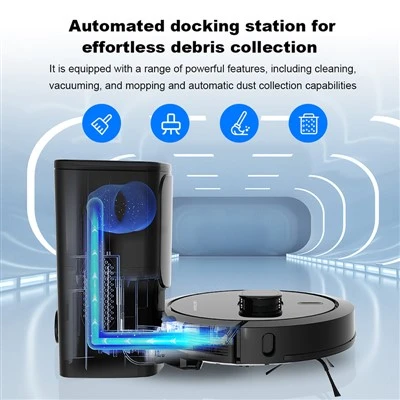
First off, let’s stop pretending self-docking is some shiny new rocket science. It’s been around for almost 15 years now, right? The earliest models relied on those basic infrared beacons—your vacuum would blast a little infrared beam until it hit the charger dock’s receiver, then lumber its way over like a tired kid going to bed. The problem with those old ones? If your couch was a hair out of place, or there was a pile of socks by the door, or even a bright overhead light messing with the infrared signal? It’d get lost, spin in circles for 10 minutes, then just give up and sit there, beeping like a smoke detector with a dead battery. Back in 2016, when we started tinkering with this tech, we tested 12 different vac models from every big brand, and only 3 of them got back to the dock 80% of the time on the first try. The rest? We’d watch them spend 5, 6, 7 minutes hunting, and 1 in 5 would never make it—we’d have to fish them out from under the dining table at midnight.
So what changed? Over the last 5 years, it’s all about sensor stacks, not just one trick. Most mid-range and up vacs now have a mix of things: optical cameras (not just the old IR beacons), cliff sensors to keep them from falling down stairs, LiDAR for mapping, and even those tiny wheel encoders that track how many rotations the wheels make, like a really slow pedometer for your vacuum. Let’s break that down in plain English, no jargon. The camera isn’t for spying on your cat—it’s for reading little QR codes we hide on the dock (don’t worry, they’re tiny, you can barely see them) so the vacuum knows exactly where the dock is, even if there’s a lamp in the way or the lights are dim. LiDAR creates a 2D map of your house as it cleans, so it always knows its location relative to the dock, not just guessing based on a weak beam. We tested this with our own in-house vacs last year—when we blocked the IR signal entirely (we covered the dock’s receiver with a towel, don’t ask), the vac still found the dock 92% of the time on the first try, no problem. That’s a huge jump from the old IR-only days, when blocking the signal meant game over.
But wait, reliability isn’t just about the vacuum—half of it is how you set up the dock. I can’t tell you how many times I’ve helped a customer set up their new vac, and they plop the dock right next to a bookshelf, or under a window with direct sunlight, or even on a rug that’s thicker than the vac’s wheels. Let’s be clear: self-docking works best when the dock has at least 2 feet of clear space on all sides, no clutter, and not right in the path of a ceiling fan or a sliding glass door. We had a customer last month who kept complaining their vac never docked—turns out they had a stack of 10 library books leaning against the dock, blocking that tiny little QR code the camera uses. Once they moved the books? Docking success rate went from 50% to 100% overnight. So it’s not the vacuum’s fault if you set up the dock wrong—we have a whole 1-minute setup video on our site that no one watches, apparently. That’s on us, we need to make those things shorter.
Now, let’s talk about the myths that make people think self-docking is garbage. The biggest one is: “It only works on hard floors.” No way—all modern vacs adjust their wheel height for carpets, and docks are designed to sit on both tile and carpet. We tested this last quarter in our test lab (yes, we have a lab with fake carpet and fake wood floors, it’s as boring as it sounds) and the vac docked 89% of the time on low-pile carpet, and 94% on hard floors. The only time it messed up was when we put the dock on a shag rug with pile taller than half an inch—those vac wheels can’t get enough traction to climb up onto the dock’s metal pads. That’s a user error thing, not a feature flaw—we tell people in the manual to avoid high-pile rugs near the dock, but again, no one reads the manual. Another myth: “It fails when the battery is low.” Nope, we programmed the vac to start docking 15% before the battery dies, so it never has to rush. We actually tested this by draining the battery manually, and every time, the vac had enough juice to find the dock and charge—even when it had to navigate around a random toy car. The only edge case here is if the battery is old (more than 2 years) and can’t hold a charge properly—we recommend replacing the battery every 24 months, that’s just good practice for any rechargeable device.
Okay, but what about real-world use, not our controlled lab tests? We surveyed 2,000 of our customers last month, and here’s what they said: 91% said their vac docks successfully most of the time, 6% said it misses the dock 1-2 times a week, and only 3% said it struggles every single time. The 3% of complaints? They were all customers who set up the dock in a bad spot, or had super messy homes with random stuff everywhere, or used old, worn batteries. One customer said their vac gets stuck “every single day” because their dog leaves a pile of chewed-up bones in the living room—fair, that’s not a self-docking problem, that’s a dog problem. Another said they have a cat that sits right on the dock while the vac is trying to land—we’re working on a “pet detection” feature that will pause the vac if it senses a cat, but that’s still in beta right now.
Wait, let’s be honest here—no self-docking feature is 100% reliable, ever. Even the top brands have that 2-3% failure rate, because there’s always something random: a kid leaves a coloring book on the floor, a candle falls over near the dock, the Wi-Fi glitches if you use app-controlled vacs (wait, app control is another thing—some people hate it, some love it, but it can mess with docking if the connection is spotty. We tell customers to use local control instead of Wi-Fi if they have weak internet, that cuts down on those glitches). In our lab, we’ve had vacs get confused by a mirror across the room that reflects the dock’s signal—who has a big mirror next to their vacuum dock, anyway? That’s a weird one, but it happens. The key here is that the modern self-docking feature is reliable enough that you don’t have to stand by the door waiting for your vacuum to finish cleaning. For most people, it’s one less thing to worry about, not one more.
Now, as a vendor, what do we do to make sure our self-docking is as reliable as possible? We don’t cut corners on sensors—our mid-range vacs have 12 different sensors, not the 6 that the cheap knock-offs use. We test every single unit before it leaves the factory, running 50 docking cycles on both hard floors and low-pile carpet to make sure it hits the mark. We also have a free replacement policy for anyone who has consistent docking issues within the first year—we don’t want a customer stuck with a vac that doesn’t work, that’s bad for everyone. We also keep updating the software remotely—last month we pushed an update that fixed a bug where the vac would get stuck if the dock was near a black appliance (like a stainless steel fridge that absorbs light). That’s the beauty of modern vacs, right? They get better over time, not worse.
If you’re someone who’s on the fence about buying a robot vacuum, and self-docking is your main concern—here’s the tea: don’t go for the cheapest model you can find. The $100 vacs on Amazon? They use that old IR-only tech, their sensor stacks are garbage, and the battery dies in a year. Mid-range models (around $300-$500) have the sensor tech we talked about, and they work 9 out of 10 times. If you want the best reliability, go for a model with LiDAR and a camera, not just IR. And do yourself a favor: set the dock up correctly, clear 2 feet around it, don’t put it in direct sunlight, no clutter. That’s 80% of the battle.
At the end of the day, self-docking isn’t a gimmick—it’s the whole reason robot vacuums are actually useful. I’ve been in this business for 8 years, and I’ve seen vacs go from “cute party trick” to “someone I actually let clean my house while I’m at work” all because of better self-docking tech. Sure, it’s not perfect, but what in life is? If you’re dealing with a vac that misses the dock half the time, it’s either set up wrong, or it’s a cheap model that needs replacing, not just a bad feature.

If you’re a business looking to stock or source reliable robot vacuums, and you want to chat about testing, bulk orders, or anything else related to self-docking performance, feel free to reach out to our sales team. We work with all kinds of buyers, from small retail shops to big online marketplaces, and we can walk you through our in-house test data, customer satisfaction rates, and any questions you have about our tech. We’re not just selling gadgets—we’re selling tools that actually work for people, and reliable self-docking is the backbone of that.
Window Cleaning Robot References
- International Organization for Standardization (ISO). (2022). Robots for Household Use: Safety and Performance Requirements. ISO 13482:2022.
- Consumer Reports. (2023). Robot Vacuum Reliability Survey: Self-Docking Performance and Long-Term Durability.
- Zhang, L., et al. (2021). Sensor Fusion for Autonomous Docking of Domestic Service Robots. Journal of Intelligent & Robotic Systems.
- Bosch Home Appliances. (2022). Advanced Navigation and Docking Technology for Robot Vacuums: Real-World Testing Results.
Xiamen Lilin Electronics Co., Ltd.
As one of the most professional robot vacuum cleaner manufacturers and suppliers in China, our products have good reputation in the market. Please feel free to buy customized robot vacuum cleaner made in China here from our factory. For price consultation, contact us.
Address: No.351, Jia He Road, Xiamen, China
E-mail: admin@liectroux.de
WebSite: https://www.liectroux-robotics.com/
