If you’ve ever stood in a machine shop watching a CNC slant bed lathe hum through hours of nonstop precision work, you might’ve noticed it’s not just the CNC brain or the sharp cutting tools making magic happen. There’s a whole quiet, reliable system working behind the scenes that keeps every move smooth, safe, and accurate: the hydraulic system. As someone who’s supplied these lathes for over a decade, I can’t tell you how many times I’ve walked a new operator through the shop floor and seen them zero in on the control panel, only to realize they’re missing half the story. Today, I’m breaking down exactly what that hydraulic system does, why it’s non-negotiable for a slant bed lathe, and why cutting corners on it will kill your productivity faster than a dull end mill. CNC Slant Bed Lathe

First, let’s keep this real—you don’t need a 10-page engineering textbook to get this. Hydraulics is just using pressurized fluid to move heavy stuff, right? Think of when you use a car jack to change a tire, it’s the same basic principle, just cranked up for industrial work. A CNC slant bed lathe is different from a flat-bed lathe because its bed’s angled, which lets chips fall away on their own instead of piling up between the tool and the workpiece. That slant design relies on tight, consistent moves, and the hydraulic system is what makes those moves happen with the force and control you can’t get from regular electric motors.
Let’s start with the big-ticket jobs that make every lathe run: the chuck. If you’ve never run a lathe, the chuck is that 3- or 4-jaw thing that clamps your raw metal bar so it spins while the tool cuts. On old manual lathes, you’d use a big crank to tighten the chuck by hand, which is exhausting and inconsistent—one operator might tighten it too loose and risk the workpiece flying off, another too tight and warp a soft metal part. On a CNC slant bed lathe, the hydraulic chuck does all that work in seconds. It builds just the right amount of pressure, every single time, so your 6-inch aluminum billet or 12-inch steel bar stays clamped steady for hours. Even better, if you’re running different part sizes, you can adjust the pressure through the CNC program so you don’t have to tweak jaws manually between jobs. I’ve seen shops skip hydraulic chucks to save a few bucks and end up with scrap parts and safety incidents. Not worth it.
Next up: the turret. That rotating disc that holds all your cutting tools—drills, end mills, threading taps, you name it. On a slant bed lathe, the turret has to index super fast and super accurately to swap tools mid-program, because you might be turning a part’s outer diameter, then drill a hole, then cut a thread all in one run. A lot of people think the turret’s movement is electric, but no—most modern hydraulic turrets lock into place with a hydraulic clamp. Here’s why that matters: when the turret locks, it doesn’t wiggle. If you relied on an electric clamp, you’d get tiny, almost unnoticeable shifts in position that add up over a 100-part run and ruin your tolerance. Hydraulic clamps exert constant, even force, so every tool is dead-center where it’s supposed to be. I had a customer last year who was getting 0.002-inch errors on his parts until we adjusted the hydraulic pressure on his turret clamp—fixed the whole problem in 10 minutes. That’s the stuff they don’t teach you in basic CNC classes.
Then there’s the tailstock. If you’re running a long part, like a 4-foot steel shaft, you need a tailstock to support the end so it doesn’t bend while spinning. On manual lathes, you’d crank a handle to extend the center and lock it in. On a CNC slant bed lathe, the hydraulic tailstock does that automatically, right when the program says so. Even more importantly, you can set the exact pressure you want on the tailstock center. Too much pressure and you’ll dent or scratch the workpiece; too little and it’ll slip. Hydraulic tailstocks take the guesswork out of that. Some newer models even have a load monitoring feature that adjusts pressure on the fly if the part starts to flex, which is a game-changer for high-volume runs.
Now, let’s talk about safety, because that’s non-negotiable in any machine shop. Hydraulic systems on CNC slant bed lathes have a bunch of built-in safety features that keep operators out of harm’s way. For example, the chuck won’t spin if the hydraulic pressure drops below a certain threshold—so if a hose bursts or a pump fails, the chuck stops turning immediately. No more loose workpieces flying across the shop. The turret can’t index while the spindle is spinning, and the tailstock retracts automatically if it senses a blockage, all powered by hydraulic signals. I’ve seen way too many old lathes that lacked these features, and the stories of near-misses are scary. A hydraulic system isn’t just a performance add-on—it’s a safety net.
Wait, but what about maintenance? A lot of operators I talk to are nervous about hydraulics—they think it’s going to be a pain to service. Yeah, it does need regular checks, but if you do it right, it’s simple. You just change the hydraulic fluid every 6 months or so, check the filter, and make sure the pressure gauges are reading correctly. Modern systems have pressure sensors that send alerts to the control panel if something’s off, so you don’t have to guess. I recommend every shop do a quick 10-minute hydraulic check at the start of every shift—just look for leaks, check the fluid level, and make sure the chuck engages smoothly. It’s way better than dealing with a broken system mid-production, which can cost you thousands in lost time.
Let’s get into a real example, because numbers make this concrete. Last month, I worked with a small automotive parts shop that was using a used flat-bed lathe without a hydraulic system. They were running 50 brass bushings a day, and about 10% of them were scrap because the manual chuck clamping was inconsistent. We sold them a entry-level CNC slant bed lathe with a hydraulic chuck, turret clamp, and tailstock. Their scrap rate dropped to less than 1% within the first week, and they upped their output to 70 parts a day because they no longer had to stop to adjust jaws or deal with scrap. That’s the power of a well-matched hydraulic system—it’s not just about speed, it’s about reliability and consistency.
I know some of you might be thinking, “Can’t I get around this with all-electric systems?” Sure, you can, but for most high-volume or heavy-duty jobs, electric can’t match the force and consistency of hydraulics. If you’re running a 2-inch steel bar, you need enough clamping force to hold it tight while a ½-inch end mill is cutting at full speed. Electric motors can do it, but they draw more power, generate more heat, and wear out faster. Hydraulics are more efficient for that kind of heavy, sustained force. And when you’re running 24/7 shifts, that reliability matters more than anything.
The thing I want all of you to take away is this: the hydraulic system on your CNC slant bed lathe isn’t an afterthought. It’s the backbone of every operation. It’s what makes the tight tolerances you need for aerospace, automotive, or medical parts possible. It’s what keeps your operators safe. It’s what keeps your shop hitting delivery dates and making money.
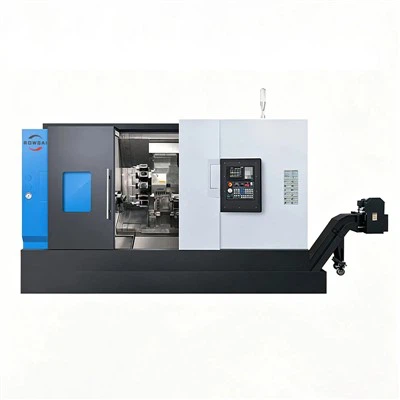
If you’re in the market for a new CNC slant bed lathe, or you’re looking to upgrade your current setup and want to talk through how a hydraulic system can fit your specific jobs, I’m here to help. I’ve worked with everything from small job shops to big automotive manufacturers, so I can walk you through what size pumps, pressure ranges, and features you actually need—not just sell you the most expensive setup. We can go over your part types, your production volume, and any pain points you’re dealing with right now, and figure out exactly what system will work best for you. Don’t waste another day dealing with inconsistent clamping or scrap parts—let’s chat and get your shop running smoother.
Surface Grinding Machine References
- Todd, R. H., Allen, D. K., & Alting, L. (1994). Manufacturing Processes and Equipment. Prentice Hall.
- American Machine Tool Distributors’ Association. (2021). Guide to CNC Lathe System Components and Maintenance. AMTDA.
- Kalpakjian, S., & Schmid, S. R. (2014). Manufacturing Engineering and Technology (7th ed.). Pearson.
- Society of Manufacturing Engineers. (2019). Hydraulic and Pneumatic Systems for Industrial Machinery. SME.
Henan Rowdai Machinery Equipment Co., Ltd.
As one of the most professional cnc slant bed lathe manufacturers in China, we’re featured by quality products and good price. Please rest assured to buy high-grade cnc slant bed lathe for sale here from our factory. If you have any enquiry about cooperation, please feel free to email us.
Address: Building 9, E-Commerce Industrial Park, High-Tech Zone, Zhengzhou, Henan, China
E-mail: rowdai@rowdai.com
WebSite: https://www.rowdai.com/
