If you’ve ever placed an order for industrial equipment, one of the first questions you ask after confirming specifications and pricing isn’t just, “Will this machine work for me?” It’s, “When will it actually be up and running on my factory floor?” As a plastic pipe machine supplier, I get asked this question at least half a dozen times a week, and the answer is never a one-size-fits-all number. Let me break down exactly what goes into installing a plastic pipe extrusion line, how long each step takes, and the small, often overlooked factors that can make the timeline stretch or shrink. Plastic Pipe Machine

First, I need to clarify: when customers ask about installation time, they’re usually talking about two separate processes. There’s the on-site installation itself, but before that, there’s the lead time from order confirmation to the machine being ready to ship, plus the planning that happens once the machine arrives. Let’s start with the timeline that most customers care about most, because that’s what drives their production schedule and revenue projections.
The most common line we sell is a 63mm to 250mm HDPE pipe extrusion line, which is the workhorse for small to mid-sized plumbing and irrigation pipe manufacturers. For that standard line, the on-site installation time is usually between three and five full working days. Wait, I hear you—why is there a two-day gap? Because it depends on how much prep work the customer does before our technicians even show up. If their production floor is already prepped with a level, reinforced concrete foundation, power supply that meets our machine’s voltage and amperage requirements (we need three-phase 480V for most of our lines, not the single-phase residential stuff), proper ventilation for fume extraction, and a space clear of debris and other equipment, we can knock out installation in three days. If they have to pour new concrete or adjust their power lines? That adds two days minimum, sometimes more, if there’s a permit delay with their local electrical inspector.
Let’s walk through those three days step by step, so you see exactly what’s happening. Day one starts with offloading and positioning the machine. This might sound simple, but our pipe machines are heavy—each extruder alone weighs around 8,000 pounds—so we need a forklift or crane that’s rated for at least 12,000 pounds to get it off the shipping container. Once it’s off, our two lead technicians will spend four to five hours leveling the extruder and the downstream equipment (the cooling tanks, haul-off, and cut-off saw) on that concrete slab. They use precision laser levels, not just a regular carpenter’s level, because even a 1/8-inch tilt in the extruder can cause uneven pipe wall thickness, which would ruin every batch. By the end of day one, the machine is in place, bolted down, and connected to the main power supply.
Day two is all about connecting auxiliary systems and running initial tests. First, we connect the cooling water lines for the extruder barrel and the vacuum calibration tank—this is critical, because if the water pressure is too low, the extruder will overheat and break down within hours of running. Then we hook up the air lines for the haul-off and the pipe cutter, and the fume extraction system to pull away the small amount of volatile organic compounds released during extrusion. Once all lines are connected, we run a “dry test” for two hours: we turn on all motors, check for leaks in water and air lines, test the PLC control panel, and make sure all emergency stop buttons work. No production yet—just making sure nothing is going to short out or leak once we start with plastic.
Day three is when we run the first test pipe and train the customer’s operators. This is usually the most exciting (and most stressful) day for both sides. We load the HDPE resin pellets into the extruder hopper, set the temperature zones to the correct settings for the pipe size they ordered, and let the machine warm up. Once the plastic is molten, it’s pushed through the die head, and we pull it through the calibration tank to get the exact outer diameter. Our technicians will make small adjustments to the screw speed, haul-off speed, and temperature over the next six hours to get the pipe wall thickness within 0.1mm of the customer’s required specification. Then, we train two of their operators to run the machine, adjust settings, perform basic maintenance like replacing screens in the extruder, and troubleshoot common issues like minor clogs. By the end of day three, if everything goes right, the customer is producing full-length pipes that meet their quality standards. Like I said, if there are prep issues before day one, that’s when the timeline slips. A few months ago, we had a customer in Texas who ordered a 110mm pipe line, and their concrete contractor poured the foundation with a ½-inch tilt. That meant we had to bring in a concrete grinder and spend an extra day leveling the slab before we could even position the machine, pushing their installation out by two days. They lost half a day of production as a result, which they were not happy about—so lesson number one: prep your space before our technicians arrive.
Now, what about larger, more complex lines? We also sell lines that make pipes up to 1200mm in diameter for municipal water and gas projects. Those lines are modular, with multiple extruders, a large calibration tank, and an automatic stacking system. For those, on-site installation takes between seven and ten working days, again depending on prep. The reason it’s longer is because the equipment is larger and more interconnected. The 1200mm line’s extruder is 16,000 pounds alone, and the calibration tank is 30 feet long, so positioning and leveling that takes twice as long as the smaller lines. The control panel is a more advanced SCADA system instead of a basic PLC, so wiring takes longer and requires more testing. Training also takes longer, because their operators need to learn how to adjust for larger pipe sizes, handle thicker walls, and troubleshoot issues specific to big diameter pipe. We had a customer in Florida order one of these large lines last year, and their only delay was that they had to wait on a permit for their new power supply—they had the space and foundation ready, but it took their city two extra days to approve the electrical work. So their installation ended up taking nine days instead of seven, which set their production back about a week.
But here’s something many customers don’t account for: the time between when you place your order and when installation can even begin. The average lead time for a standard 63mm to 250mm HDPE line is four weeks from order confirmation to shipping, then three to five days of transit, so total time from order to first production is around five weeks. For the large 1200mm lines, lead time is six to eight weeks, plus seven to ten days of transit, so total order to production time is around nine weeks. That transit time is another factor that can shift—if you’re in a remote area like Alaska or northern Canada, transit takes three extra days, and if your port has a backlog, it could take another week before our technicians can clear customs and get to your site. Last quarter, we had a customer in rural Montana whose machine got held up at the Port of Seattle for five days because of a strike at the port, which pushed their installation timeline back a full week.
Now, I’ve been in this business for 12 years, and I’ve seen how small decisions can make a huge difference in how long installation takes. I always tell customers three things to avoid delays. First, communicate your space requirements early. Send us a photo of your production floor, the dimensions of the area where the machine will go, and a copy of your electrical specs before we even build the machine. That way, we can adjust the base design if needed, instead of having to modify it on site, which adds time and cost. Second, assign a point person on your team to coordinate with our technicians. If our team shows up and no one is there to let them in, or to show them where the power lines and water hooks are, that wastes hours of time. Third, have your operators ready for training. We offer free pre-installation webinars to teach customers’ staff the basics of extrusion, so when our on-site team arrives, they can jump right into training instead of spending an hour explaining what a PLC is.
I get it—every minute your machine isn’t running is money lost. We’ve had customers turn down larger orders because their installation took longer than expected, and that’s why we’re transparent about the timeline from day one. No hidden delays, no vague answers. When a customer reaches out asking how long installation will take, we first ask three questions: what size line are they buying, is their site fully prepped (foundation, power, ventilation), and how far are they from our service center? Then we give them a clear, realistic timeline, and build a contingency plan for common issues like port delays or permit holdups.
A common mistake I see new pipe manufacturers make is waiting to prep their site until the machine is already on a shipping container. They think, “We have four weeks before it arrives, we can do it later.” But those four weeks go fast—if their concrete contractor gets backed up, or their electrical inspector’s schedule is full, that delay gets added to their total time to production. Last year, a customer in Illinois waited until the machine was two weeks away from shipping to pour their foundation, and their concrete crew had a scheduling gap that pushed the pour back a week, which added a week to their total order timeline. They were frustrated, but they learned a valuable lesson: prep early.
Another question people ask is, can installation time be faster than the numbers I gave? Theoretically, yes, but only if everything goes perfectly, and it usually doesn’t. We had a customer in Ohio a few years ago who had their foundation poured, power set up, operators trained in advance, and when our two technicians arrived, they had the smaller line up and running in two and a half days. But that’s a rare exception, not the rule. Most of the time, there’s a small hiccup— a water pressure reading that’s 5 psi too low, a section of wiring that’s not connected properly, an operator who needs a little extra training—that adds half a day or a day to the timeline. That’s why we build in a small buffer into our estimates, so customers don’t end up disappointed.
At the end of the day, the time it takes to install a plastic pipe machine isn’t just about how long it takes to bolt it down and run it. It’s about planning, communication, and attention to detail before our technicians even set foot on your site. If you’re in the market for a plastic pipe line, don’t just ask “how long until it’s installed”—ask for a breakdown of the timeline, what prep work you need to do on your end, and what potential delays could come up. That way, you can budget your time and your production more accurately.
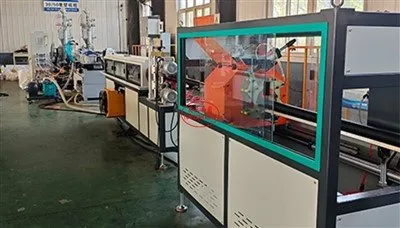
If you’re ready to get a clear, customized timeline for your plastic pipe machine installation, or if you have more questions about the process, don’t hesitate to reach out. We’re here to help you get your line up and running as quickly and smoothly as possible, so you can start producing quality pipes and growing your business.
WPC Profile Machine References:
- Extrusion Installation Best Practices, Plastic Pipe and Profile Extruders Association, 2021
- Industrial Equipment Installation Timeline and Pre-Installation Requirements, Occupational Safety and Health Administration, 2022
- HDPE Pipe Extrusion Line Specifications and Lead Times, Global Plastics Machinery Association, 2023
- On-Site Equipment Installation Efficiency Study, Industrial Maintenance and Operation Journal, 2022
Qingdao Tongsanhegu Plastic Machinery Manufacturing Co., Ltd.
With abundant experience, we are one of the most reliable plastic pipe machine manufacturers and suppliers in China. We warmly welcome you to buy durable plastic pipe machine for sale here from our factory. Quality products and reasonable price are available.
Address: West of Xixinzhi Village, Sanlihe District Jiaozhou, Qingdao City, Shandong Province, China
E-mail: info@tongsanhegu.com
WebSite: https://www.tongsanhegumachine.com/
